Tag: technology

  • ChatGPT vs Deepseek :A comparative study

    Introduction

    Welcome everyone ,

    This blog details about the performance wise comparison between DeepseekAI and ChatGPT
    Chat GPT, developed by OpenAI, is an advanced conversational model designed to generate human-like text responses based on user prompts. Its transformer model architecture allows it to understand and generate text with coherence. This makes it relevant and valuable for natural language processing. It is also important for customer service automation and content generation. Chat GPT excels in dialogue engagement and contextually appropriate responses, making it an essential tool for exploring AI in communication. One of its key aspects is the speed and efficiency of response generation, optimized for real-time interactions, which is crucial for live chat systems and interactive user interfaces. The pricing models for Chat GPT cater to various organizational needs, offering subscription-based access through its API, allowing businesses to scale usage cost-effectively. However, transparency regarding its training data and potential biases remains a concern for researchers, despite OpenAI’s efforts to address these issues.

    Deep SeekAI represents a significant advancement in AI technology, focusing on enhancing information retrieval and response generation capabilities. Unlike traditional AI models, Deep SeekAI excels in understanding and processing vast amounts of data, making it particularly useful for researchers requiring precise and comprehensive data analysis. Its deep learning-based architecture allows it to learn from extensive datasets and adapt to various research domains. Deep SeekAI stands out with its response generation speed and efficiency, leveraging advanced caching techniques and optimized algorithms that significantly reduce response times. This efficiency is beneficial for dealing with large datasets or complex queries. The cost and pricing models for Deep SeekAI are designed to accommodate different organizational needs, with flexible pricing tiers and transparency in cost estimation. Researchers also benefit from the model’s transparency regarding its training data, providing insights into dataset composition and encouraging informed usage.

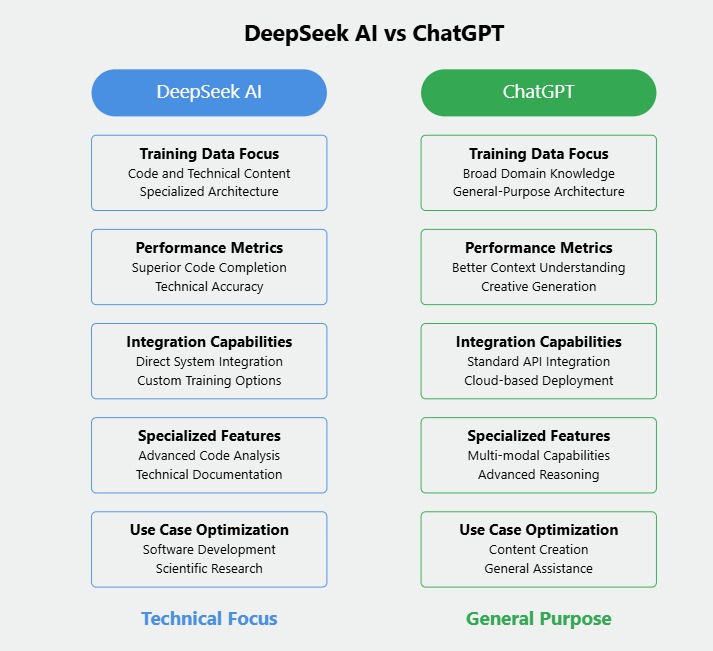
    The below figure represents the main attributes that differentiate each model from one another
    Analysis

    Response Generation Speed and Efficiency

    Definition of Response Generation Speed

    Response generation speed is the time an AI model takes to produce a response after receiving a prompt. It’s crucial for applications requiring real-time interaction, impacting user experience and practical deployment. Factors influencing speed include model complexity, training data size, and computational resources.

    In practical applications, fast response times enhance user satisfaction, especially in customer service or interactive learning environments. Organizations must consider the cost implications, as faster response times may require more advanced infrastructure.

    The quality and transparency of training data also affect response speed and overall effectiveness. Transparent training processes build trust and improve adoption rates.

    Benchmarks for Measuring Efficiency

    Efficiency benchmarks for AI models like Chat GPT and Deep SeekAI include response speed, accuracy, resource utilization, and cost-effectiveness. Researchers compare models based on average response times under various conditions and cost models.

    Training data quality and transparency are also critical. Researchers assess models on training datasets size, source, and variety, as well as the transparency of training processes.

    By establishing clear benchmarks, researchers can make informed decisions about which model best suits their needs, balancing speed, cost, and data transparency.

    Performance Analysis of Chat GPT and Deep SeekAI

    Chat GPT

    Chat GPT excels in generating coherent and contextually relevant responses across a variety of topics, making it ideal for conversational applications. Its transformer model architecture allows it to maintain context over extended dialogues, enhancing user experience. However, it can sometimes produce inaccuracies or exhibit biases reflective of its training data.

    In terms of response generation speed, Chat GPT performs well under moderate load conditions, delivering real-time responses suitable for immediate feedback applications. However, its performance can fluctuate depending on input complexity and deployment environment. Cost and pricing models vary, with options catering to different usage patterns and deployment strategies, appealing to startups and smaller enterprises.

    Training data and model transparency are crucial for understanding Chat GPT’s performance and reliability. The model is trained on diverse internet text, contributing to its versatility. However, the lack of transparency regarding specific datasets and performance metrics can raise concerns about reliability and ethical use.

    DeepseekAI

    Deep SeekAI is notable for its ability to generate contextually relevant responses across various domains, making it beneficial for academic and technical fields. Its advanced algorithms improve contextual comprehension, providing more accurate and relevant outputs.

    Deep SeekAI demonstrates impressive performance in response generation speed and efficiency, particularly in processing long queries or multi-turn conversations. This efficiency is vital for researchers relying on quick access to information. Cost and pricing models are flexible, catering to various organizational needs, from startups to large enterprises.

    The model’s training data, which includes academic literature and technical documents, enhances its ability to generate informed responses relevant to specialized fields. Model transparency is a strong point for Deep SeekAI, providing insights into its algorithms and decision-making processes, fostering trust among users.

    The table below represents the performance comparison

    Cost and Pricing Models for Businesses

    Overview of Pricing Structures in AI Tools

    Understanding the cost structures of AI tools like Chat GPT and Deep SeekAI is crucial for researchers. Chat GPT operates on a subscription-based model with different usage tiers, allowing users to pay based on their needs. This can be especially beneficial for academic environments with limited and sporadic funding, as it offers flexibility and helps forecast expenses for better budget allocation. In contrast, Deep SeekAI combines subscription and licensing fees, targeting enterprise-level applications. Although this may result in higher upfront costs, it provides customization and scalability, which can be valuable for organizations seeking comprehensive solutions.

    Additionally, researchers need to be aware of potential extra costs, such as data storage fees, premium features, and technical support. Both tools may have usage limits, leading to overage charges if exceeded. Evaluating these hidden costs is essential to understand the total cost of ownership and manage the overall budget effectively. When choosing between Chat GPT and Deep SeekAI, researchers must consider not only the pricing structures but also factors like response speed, efficiency, and training data quality to make informed decisions that align with their project objectives.

    Training Data and Model Transparency

    Importance of Training Data in AI Models

    Training data is the foundation of AI models, influencing their ability to generate coherent and contextually relevant responses. For Chat GPT and Deep SeekAI, the quality, diversity, and volume of training data are critical for performance.

    The below shows the table wise comparison

    Data Sources for Chat GPT

    Chat GPT’s effectiveness relies on diverse and high-quality training data sourced from books, websites, and various written materials. This extensive dataset allows Chat GPT to learn language patterns, nuances, and contextual meanings, resulting in coherent and contextually relevant responses across multiple topics. However, the lack of transparency regarding specific datasets and sources raises concerns about potential biases and accountability.

    Data Sources for Deep SeekAI

    Deep SeekAI utilizes a specialized approach to data sourcing, focusing on domain-specific knowledge from academic journals, research papers, industry reports, and real-time databases. This targeted approach enhances its ability to generate accurate and contextually appropriate responses in specialized fields like medicine, technology, and law. Deep SeekAI’s transparency about its data sources fosters trust, making it a reliable tool for researchers seeking precise and reliable outputs in niche areas.

    Comparison

    • Chat GPT: Broad dataset, versatile responses, concerns about transparency and bias.
    • Deep SeekAI: Specialized datasets, accurate in niche areas, transparent about data sources.

    Transparency in Model Training

    Transparency in AI model training is crucial for evaluating performance, reliability, and ethical implications.

    Chat GPT:

    • Developed by OpenAI with diverse datasets from the internet.
    • General principles of training are shared, but specific datasets are undisclosed.
    • Emphasizes diverse data to enhance text generation but raises concerns about potential biases and limitations.

    Deep SeekAI:

    • Provides explicit information about training data and methodologies.
    • Detailed documentation allows researchers to understand biases and strengths.
    • Openness about training framework aids reproducibility in research.

    Implications:

    • Transparency in training methodologies impacts response speed and efficiency.
    • Understanding training processes helps researchers choose models that align with ethical considerations and performance needs.

    Use Cases and Applications

    The below table represents the comparison of Applications & use cases of DeepseekAI and chatGPT

    Conclusion and Future Directions

    Conclusion

    Future Trends in Conversational AI

    Future trends in conversational AI will significantly transform the landscape, especially with models like Chat GPT and Deep SeekAI competing for supremacy. Advancements in natural language processing and machine learning will result in more sophisticated conversational agents with optimized algorithms for real-time interactions and minimal latency. The integration of multimodal capabilities will be crucial, allowing these AI systems to process text, voice, and visual data seamlessly, thereby enhancing user experience and application versatility.

    Flexible cost and pricing models will emerge to cater to varying business scales, with pay-per-use and scalable subscription services becoming more common. Transparency in model training will be vital, with clear communication about data sources and training methodologies driving user trust and adoption. Researchers will need to focus on how Chat GPT and Deep SeekAI address these transparency concerns.

    Continuous improvements in training methodologies will lead to more robust and adaptable models. Efficient transfer learning methods will allow AI agents to learn from smaller datasets while achieving high performance, making conversational AI a pivotal tool across various domains. These trends will shape the future of conversational AI, enhancing capabilities and accessibility.

    Final Thoughts on Chat GPT vs. Deep SeekAI

    In summarizing the comparison between Chat GPT and Deep SeekAI, it’s important to acknowledge the unique strengths and weaknesses of each system for researchers.

    Chat GPT excels in generating coherent and contextually relevant responses across diverse topics, making it particularly useful for drafting documents, brainstorming ideas, and engaging in conversational simulations. In contrast, Deep SeekAI focuses on information retrieval and analytical reasoning, offering precise insights by sifting through extensive datasets, ideal for researchers who prioritize data-driven conclusions.Response generation speed and efficiency are critical considerations. Chat GPT typically delivers rapid response times, advantageous in fast-paced research environments. Conversely, Deep SeekAI’s comprehensive analysis may result in slightly longer response times but often leads to more accurate and detailed outputs. Researchers must balance the need for speed against the depth of analysis required for their specific projects.

    Cost and pricing models significantly differentiate the two platforms. Chat GPT’s subscription-based model offers flexibility for various budgets, making it accessible to individual researchers and larger institutions. Deep SeekAI’s usage-based pricing model can lead to higher costs for extensive data queries, requiring researchers to consider funding constraints and project requirements.

    Training data and model transparency are crucial factors. Chat GPT’s diverse dataset enhances its versatility, but the lack of transparency regarding specific training data may raise concerns. Deep SeekAI emphasizes clarity about its data sources and methodologies, enhancing trust and reliability. For researchers involved in sensitive or ethical inquiries, understanding the underlying data and model training is essential for maintaining rigorous academic standards. Ultimately, the choice between Chat GPT and Deep SeekAI depends on researchers’ specific needs and priorities. Chat GPT offers speed and versatility, while Deep SeekAI provides depth and transparency in data analysis. Each system caters to different research aspects. As AI technology evolves, researchers must stay informed about these tools’ capabilities and limitations. This knowledge allows them to make strategic decisions. These decisions enhance their work and contribute meaningfully to their fields of study.

    Vote of thanks

    I extend my sincere gratitude to Dr. Ranjith Gopalan and aimldatascienceacademy. He took valuable time to review this article and provided feedback. This feedback helped enhance its quality and impact.


  • Creative Horizons: Harnessing Generative AI for Innovative Image Creation

    Creative Horizons: Harnessing Generative AI for Innovative Image Creation

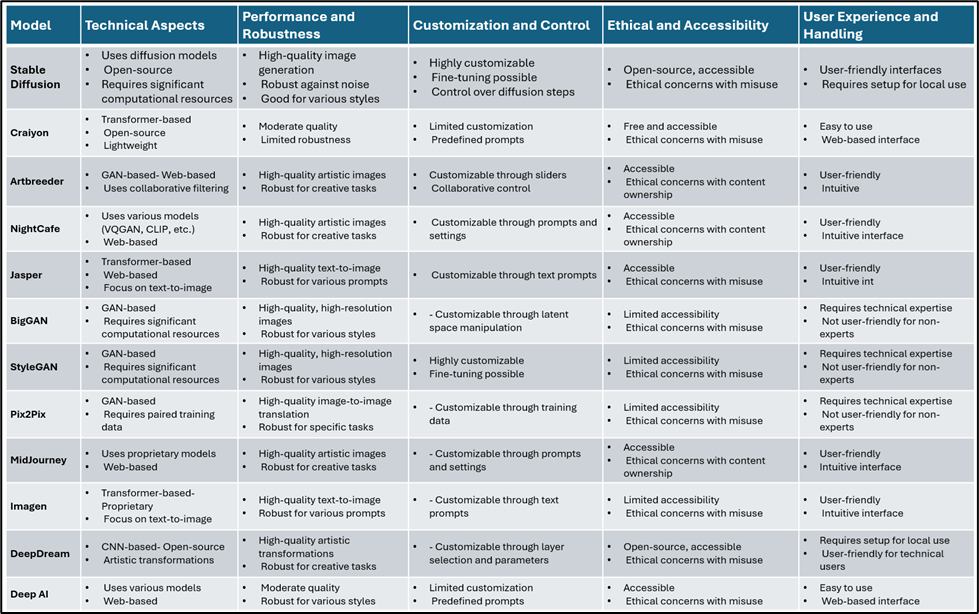
    Here we are talking about detailed comparison from the various execution result on mentioned Gen AI models in terms of parameters like Technical Aspects, Performance and Robustness, Customization and Control, Ethical and Accessibility and User Experience and Handling of these technologies based on the following parameters. Please refer Fig01

    Fig 01 presents a comprehensive comparison of Gen AI models used for image creation.

    Visual analysis and inference

    Let us undertake a detailed comparative analysis of four distinct models: Stable Diffusion, Craiyon, Artbreeder, and NightCafe. Chosen for their broad adoption, varied technological methodologies, and distinctive features, our aim is to rigorously assess and compare each model’s performance and artistic prowess. This will be achieved by testing them against six carefully curated and demanding case scenarios, each designed to cover a broad range of visual content. This approach ensures a comprehensive evaluation of the models’ abilities. The assessment criteria will focus on image quality, consistency, artistic expression, and the precision of converting textual prompts into corresponding visual representations.

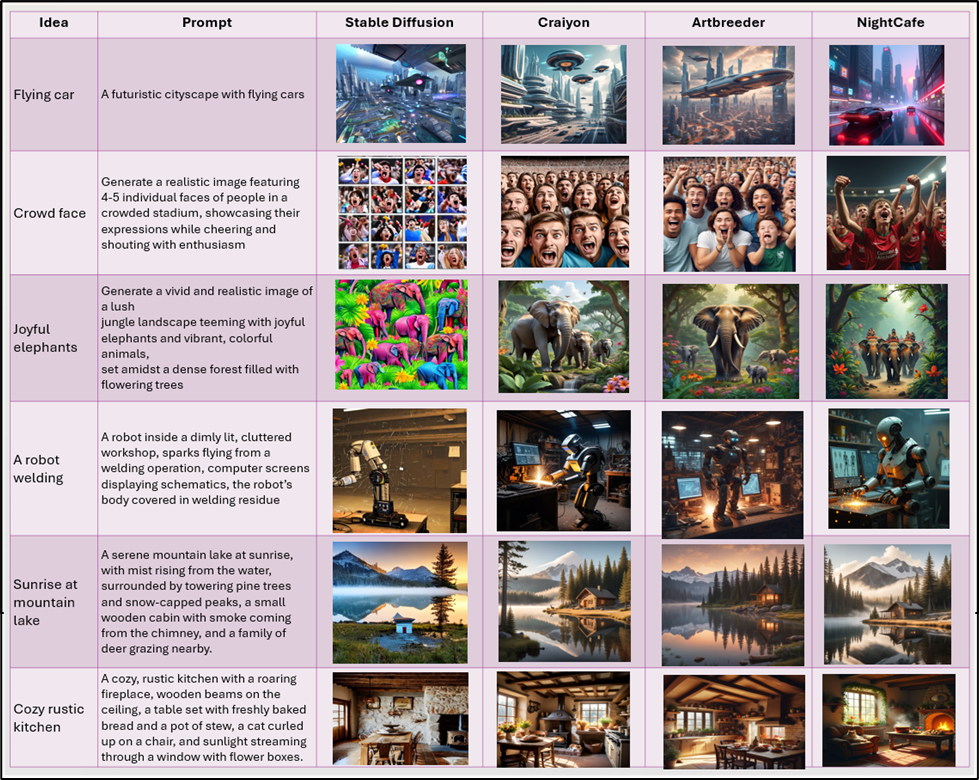
    The six distinct case scenarios (Flying car, Crowd face, Joyful elephants, A robot welding, Sunrise at mountain lake, Cozy rustic kitchen) (Fig 02) were chosen for the analysis because they represent a broad spectrum of visual content.

    This thorough comparative analysis is designed to illuminate the strengths and weaknesses of each model, as well as their appropriateness for various artistic and practical endeavors. By assessing their capabilities in demanding situations, we provide artists, developers, and researchers with the necessary insights to choose an image synthesis technology that best fits their unique creative or functional goals.

    Fig 02 shows a comparison of images generated by AI models, created using specific prompts.

    Please see the comprehensive comparison of the four models across our six test scenarios. This analysis offers valuable insights into the distinct strengths and limitations of each model, empowering users to select the most suitable technology for their specific needs and objectives, whether they are pursuing creative, practical, or research-oriented tasks.

    Flying car:

    • Stable Diffusion: The images were visually striking and captured the futuristic theme well, with minor issues in rendering some elements like flying cars.The cityscape was well-rendered with a futuristic look.
    • Craiyon: Good overall quality with detailed cityscapes but occasional distortions in flying cars. The flying cars were present but sometimes appeared slightly distorted or out of proportion.
    • Artbreeder: The images were aesthetically pleasing and creative, capturing the essence of a futuristic cityscape, but with a more artistic rather than realistic approach. Artistic and visually appealing images with well-integrated but stylized flying cars.
    • Nightcafe: Nightcafe exhibited the poorest performance among the models. The cityscape lacked detail and coherence. The flying cars were either missing or poorly rendered, often blending into the background.

    Crowd face 

    • Stable Diffusion: Poor performance with lack of detail and coherence in both faces and background. The expressions were not well-captured, often appearing unnatural or missing entirely.
    • Craiyon: Vibrant and detailed images with realistic expressions and a coherent background, capturing the prompt effectively. The images were visually striking and captured the prompt well, with minor issues in rendering some elements.
    • Artbreeder: Artistic and visually appealing images with well-captured expressions but more stylized than realistic. The background was present and integrated well with the faces, though it had an artistic rather than realistic look.
    • Nightcafe: Good overall quality with detailed faces and expressions, though occasional distortions were present. The background of the stadium was present but sometimes lacked detail and coherence.

    Joyful elephants

    • Stable Diffusion: Poor performance with lack of detail and coherence in both the landscape and the animals. The elephants and other animals were poorly rendered, often blending into the background or appearing unnatural.
    • Craiyon: High-quality images with detailed and vivid jungle landscapes, well-rendered elephants, and vibrant animals. The background was detailed with dense foliage and flowering trees, adding to the overall realism.
    • Artbreeder: Vibrant and detailed images with realistic jungle landscapes, joyful elephants, and colorful animals, capturing the prompt effectively. The background was detailed and coherent, with dense foliage and flowering trees adding to the overall realism.
    • NightCafe:. Artistic and visually appealing images with well-integrated but stylized animals and a creative jungle landscape. The elephants and other animals were well-integrated into the scene, though they sometimes appeared more stylized than realistic.

    A robot welding

    • Stable Diffusion: Poor performance with lack of detail and coherence in both the workshop and the robot. The images were far from realistic, with a lack of clear structure and detail in both the workshop and the robot.
    • Craiyon: High-quality images with detailed and realistic workshop environments, well-rendered robots, and welding operations. The images were vivid and realistic, capturing the essence of a robot welding in a cluttered workshop.
    • Artbreeder: Artistic and visually appealing images with well-integrated but stylized robots and a creative workshop environment. The robot and welding operation were well-integrated into the scene, though they sometimes appeared more stylized than realistic.
    • Nightcafe: Vibrant and detailed images with realistic workshop environments, accurate robot and welding operations, capturing the prompt effectively. The robot and welding operation were depicted accurately, with sparks flying and welding residue visible on the robot’s body.
    • sunrise at mountain lake
      • Stable Diffusion: Not biased performance with small lack of detail and coherence in both the lake and the surrounding environment.  The images were far from realistic, with a lack of clear structure and detail in both the lake and the surrounding environment.
      • Craiyon: High-quality images with detailed and realistic lake environments, well-rendered surrounding elements, and integrated cabin and trees. The images were vivid and realistic, capturing the essence of a serene mountain lake at sunrise. 
      • Artbreeder: Artistic and visually appealing images with well-integrated but stylized elements and a creative lake environment. The images were aesthetically pleasing and creative, capturing the essence of a serene mountain lake at sunrise with a more artistic approach.
      • Nightcafe: Vibrant and detailed images with realistic lake environments, accurate surrounding elements, and well-integrated cabin and deer, capturing the prompt effectively. The towering pine trees and snow-capped peaks were depicted accurately, adding to the overall realism.

    Cozy rustic kitchen

    • Stable Diffusion: High-quality images with detailed and realistic kitchen environments, well-rendered fireplace, wooden beams, table setting, cat, and sunlight. The table set with freshly baked bread and a pot of stew was detailed and realistic.
    • Craiyon: The images were vivid and realistic, capturing the essence of a cozy, rustic kitchen. The cat curled near to fireplace and the sunlight streaming through the window with flower boxes were well-integrated into the scene.
    • Artbreeder: Artistic and visually appealing images with well-integrated but stylized elements and a creative kitchen environment. The cozy, rustic kitchen ambiance was well-captured with realistic lighting.
    • Nightcafe: Vibrant and detailed images with realistic kitchen environments, accurate fireplace, wooden beams, table setting, cat, and sunlight, capturing the prompt effectively. The table setting with bread and stew was present but had an artistic rather than realistic look

    Discussion

    We all talk about how generative AI models have the potential to revolutionize the creative industry, what are the general model algorithms and most useful Geni AI solution in the market and compared images created by it. We also need to discuss challenges as well.

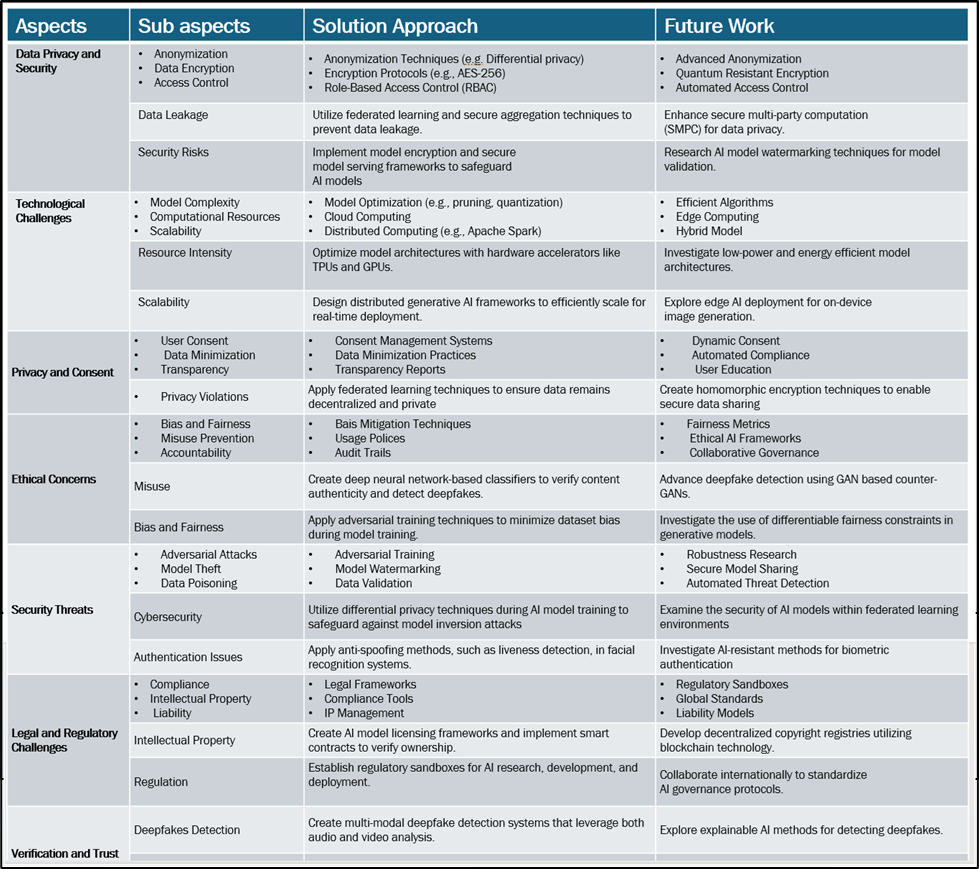
    The challenges associated with including Generative AI (GAI) in imaging are multifaceted and require a comprehensive approach. Let us List those and discuss them in detail in the below table. Please refer Fig 03

    Fig 03 presents challenges in Generative AI (GAI) imaging and probable solutions

    To summarize, the integration of Generative AI into imaging presents a multitude of challenges spanning ethical, privacy, security, legal, and technological aspects. Tackling these issues necessitates a comprehensive strategy that includes technical solutions, continuous research, and interdisciplinary and international cooperation.

    Future Directions

    The advancement of artificial intelligence has revolutionized artistic practices, leading to the creation of dynamic AI art communities dedicated to fostering collaboration and innovation. As research into generative image creation deepens, it’s crucial to consider the future trajectory of these communities. Trends suggest a growing focus on interdisciplinary collaboration, uniting artists, technologists, and academics to push the limits of creativity. This fusion of varied insights is anticipated to produce more nuanced artistic works and spur the development of novel techniques surpassing conventional approaches.

    Moreover, the increasing accessibility of AI tools promises to make the creative process more democratic, allowing a wider array of people to engage with AI art communities. Progress in intuitive interfaces and open-source platforms will enable beginners and hobbyists to delve into generative AI, creating a welcoming space for education and idea exchange. This evolution will not only foster a sense of community but also propel innovation through shared creativity. These focused collectives will support concentrated research and trials, significantly contributing to the larger AI art community. By dedicating efforts to specific uses of generative AI, researchers aim to discover new methods and enhance existing ones.

    As technology evolves, it is essential to remain proactive in addressing these issues and driving innovation in the field. Future improvements for generative AI in multimedia include:

    AI-powered Story Weaving: Generative AI tools can assist multimedia developers in crafting their stories by generating various concept art sketches from high-level story descriptions or suggesting visually captivating multimedia that aligns with the narrative’s emotional tone. This enhances both agility and creativity in the development process.

    Interpretable AI in Multimedia: Creating explainable AI techniques tailored for the multimedia domain enables users to comprehend the reasoning behind AI-generated content. This approach promotes trust and transparency.

    Technological Advancements: Future efforts should aim to enhance the realism, quality, scalability, robustness, and semantic coherence of multimedia. Investigating the integration of various generative AI models (such as VAEs, GANs, Transformers, and Autoregressive Models) can spur innovation. Additionally, advancing data compression techniques will facilitate the efficient storage and transmission of multimedia content.

    Countering Deepfakes and Disinformation: Research findings can guide the creation of effective deepfake detection techniques specifically designed for the multimedia field. This enables users to critically assess multimedia content and reduce the spread of misinformation.

    User Behavior Analysis: Creating generative AI models that dynamically adjust to user preferences in real-time has the potential to transform multimedia content delivery. By offering personalized and customized content, we can ensure that each user gets exactly what they desire, enhancing their engagement and satisfaction.

    Image synthesis technology has the potential to transform numerous fields. Here are some key areas it can influence:

    Materials Science: AI can facilitate virtual testing and optimization of new material properties before they are physically created, speeding up innovation. Additionally, it plays a vital role in simulating material degradation over time, enabling non-destructive testing, preventative maintenance, and enhancements in infrastructure safety.

    Medical Imaging: Image synthesis can improve early disease detection by analyzing medical scans, like mammograms, to spot subtle anomalies, resulting in better patient outcomes. Additionally, it enables doctors to simulate treatment effects on a patient’s condition, allowing for personalized treatment plans and enhancing surgical results through AI-generated 3D models of organs and tissues.

    Space research: AI can enhance planetary imaging by analyzing telescope data to eliminate noise and improve images of distant planets, uncovering essential atmospheric details and the potential for life. Furthermore, AI can create simulations of Martian landscapes, supporting mission planning and astronaut training.

    Conclusion

    The intersection of technology and the arts within the multimedia sphere has long fascinated researchers. The advent of Generative AI marks a pivotal shift in this narrative, fundamentally altering the production of multimedia and the collaborative nature of creation. Generative AI has been a game-changer in image generation, expanding the horizons of creativity and partnership. It has not only enhanced human creative capabilities but also made the content creation process more efficient, encouraging new forms of collaboration between AI systems and human artists. The paper thoroughly examines cutting-edge Generative AI models, such as Stable Diffusion, Craiyon, Artbreeder, NightCafe, Jasper, BigGAN, StyleGAN, Pix2Pix, Midjourney, IIMAGEN, DeepDream, Deep AI, and DALL-E 2, evaluating their effectiveness in terms of image quality, diversity, interpretability, and computational efficiency. This integration of AI with image generation delves into text-to-image synthesis, where AI converts textual descriptions into compelling visual art. Nonetheless, this advancement also reveals a complex web of ethical dilemmas and challenges.

    The future of AI art communities is poised for significant transformation, driven by interdisciplinary collaboration, increased accessibility, specialization, and ethical considerations. As researchers navigate this dynamic landscape, their contributions will play a vital role in shaping the trajectory of generative image creation. By embracing these future directions, AI art communities can enhance their impact on the broader artistic ecosystem, redefining the role of technology in creative expression. The ongoing dialogue between researchers, artists, and technologists will be essential in unlocking the full potential of AI as a transformative force in the world of art.

  • Reinforcement Learning Techniques for Chatbot Development

    Reinforcement Learning Techniques for Chatbot Development

    Fundamentals of Reinforcement Learning

    Reinforcement Learning (RL) is a dynamic machine learning paradigm that focuses on how agents should take actions in an environment to maximize cumulative rewards. Unlike supervised learning, where models learn from labeled data, RL employs a trial-and-error approach, enabling agents to learn optimal behaviors through interactions. This framework is particularly beneficial for chatbot development, as it allows these systems to adapt and respond more effectively to user inputs by learning from past experiences. By incorporating RL techniques, developers can create chatbots that not only improve over time but also provide better user experiences.

    At the heart of reinforcement learning are several core concepts, including agents, environments, actions, states, and rewards. The agent is the chatbot itself, which interacts with the environment, representing the user and the context of the conversation. Each interaction generates a state that the agent must evaluate to determine the most appropriate action to take next. The reward signal, which can be positive or negative, provides feedback on the effectiveness of the action taken. This feedback loop is crucial for reinforcing desired behaviors and improving the chatbot’s performance over time.

    Incorporating reinforcement learning into chatbot design involves careful consideration of performance metrics. These metrics help in evaluating how well the chatbot is learning and adapting to user needs. Common metrics include user satisfaction scores, response accuracy, and engagement levels. By analyzing these performance indicators, researchers can fine-tune the RL algorithms to ensure that the chatbot is not only meeting user expectations but also evolving to accommodate changing preferences. This iterative process is essential for developing robust chatbots that maintain high levels of user engagement.

    Real-time adaptation is another significant advantage of reinforcement learning in chatbot development. As chatbots interact with users, they can continuously learn from each conversation, allowing them to adjust their responses based on immediate feedback. This adaptability is crucial for enhancing user experience, as it enables the chatbot to provide more relevant and context-aware interactions. Moreover, RL empowers chatbots to customize their personalities and communication styles, tailoring their responses to fit individual user preferences, thereby making interactions more personal and engaging.

    Ethical considerations also play a vital role in the application of reinforcement learning to chatbots. Developers must ensure that the learning processes do not lead to biased or harmful behaviors. This requires implementing safeguards and monitoring mechanisms to assess the impacts of learned behaviors on user interactions. By addressing these ethical concerns, researchers can contribute to the development of responsible AI systems that prioritize user welfare while leveraging the powerful capabilities of reinforcement learning. Through careful integration and evaluation, chatbots can become not only more effective conversational agents but also trustworthy companions in various digital interactions.

    Key Algorithms for Chatbot Reinforcement Learning

    Reinforcement learning (RL) has emerged as a pivotal approach in the development of advanced chatbots, allowing for more adaptive and responsive interactions with users. At the core of RL are key algorithms that facilitate the training process by utilizing rewards and penalties to optimize chatbot behavior. Prominent algorithms such as Q-learning, Deep Q-Networks (DQN), and Policy Gradients play crucial roles in enabling chatbots to learn from their interactions and improve over time. These algorithms provide the foundational structure necessary for chatbots to adapt their responses based on user feedback and engagement, effectively enhancing user experience and satisfaction.

    Q-learning is one of the simplest and most widely used RL algorithms, characterized by its model-free approach. It allows chatbots to learn an optimal action-selection policy by estimating the value of different actions in various states through a value function. In the context of chatbot development, Q-learning can be applied to determine the best response based on the current state of the conversation, enabling the bot to make informed decisions that maximize user engagement. Although Q-learning is effective for smaller state spaces, its performance may diminish in more complex scenarios, prompting the need for more sophisticated algorithms like DQN.

    Deep Q-Networks extend the principles of Q-learning by integrating deep learning techniques, allowing chatbots to handle vast and intricate state spaces more efficiently. By employing neural networks to approximate the value function, DQNs can process high-dimensional input data, such as text and user interactions, transforming them into actionable policies. This capability is particularly beneficial for chatbots that require nuanced understanding and context awareness, as it enables them to generate more relevant and contextually appropriate responses.

    Policy Gradient methods, another category of RL algorithms, focus on optimizing the policy directly rather than relying on value function estimation. This approach is advantageous in scenarios where the action space is large and complex, such as in natural language processing tasks. By adjusting the policy based on the rewards received from user interactions, these methods allow chatbots to explore a wider range of potential responses and adapt their behavior to maximize positive user experiences. Implementing Policy Gradient techniques can lead to more personalized and engaging chatbot interactions, ultimately enhancing user satisfaction.

    In summary, the integration of key reinforcement learning algorithms into chatbot development enables the creation of sophisticated systems that can learn and adapt in real-time. By leveraging Q-learning, DQNs, and Policy Gradient methods, developers can design chatbots capable of refining their responses based on user feedback and interactions. This not only improves the performance of chatbots but also paves the way for more engaging and effective communication between users and machines. Understanding these algorithms is essential for students and researchers aiming to master the art of chatbot design and user experience optimization through reinforcement learning.

    Training Chatbots Using Reinforcement Learning

    Training chatbots using reinforcement learning (RL) represents a significant advancement in the field of artificial intelligence, particularly in enhancing user interactions. The core principle of reinforcement learning lies in the agent’s ability to learn optimal behaviors through trial and error, receiving feedback in the form of rewards or penalties. In the context of chatbots, this means that the bot can be trained to improve its responses based on user engagement and satisfaction metrics. By implementing RL, developers can create chatbots that not only respond to queries but also adapt their behavior to better meet user needs over time.

    The training process involves several key components. First, a reward function must be established, which quantifies the chatbot’s performance based on specific user interactions. This function can include metrics such as user retention, response accuracy, and overall user satisfaction. By defining these parameters, developers can provide the chatbot with clear goals to achieve during its training phase. The RL algorithm then allows the chatbot to explore various response strategies, learning from both successful interactions and failures to refine its approach. This continuous feedback loop leads to a more intuitive and responsive chatbot over time.

    One of the critical advantages of reinforcement learning in chatbot development is its capacity for real-time adaptation. As chatbots engage with users, they gather data that can inform immediate adjustments in their response strategies. This ability to learn on-the-fly enhances user experience by ensuring that the chatbot remains relevant and engaging. For example, if a chatbot notices a particular type of response leads to higher user satisfaction, it can prioritize similar responses in future interactions. This dynamic adaptability is essential in maintaining user engagement and satisfaction in an increasingly competitive landscape.

    However, the application of reinforcement learning in chatbot training is not without its challenges. Ethical considerations must be addressed, particularly regarding user privacy and the potential for unintended biases in chatbot behavior. Developers must ensure that the reward functions they design do not inadvertently reinforce negative behaviors or lead to the marginalization of certain user groups. Additionally, transparency in how chatbots learn and adapt is crucial for building user trust. Researchers and students in the field must remain vigilant about these ethical implications as they explore the capabilities of RL in chatbot development.

    In conclusion, the integration of reinforcement learning techniques into chatbot training paves the way for creating more sophisticated and user-centered conversational agents. By leveraging real-time data and feedback, developers can craft chatbots that deliver personalized experiences and continually evolve to meet user needs. As the field progresses, ongoing research and collaboration will be essential in addressing the challenges and ethical considerations that arise, ensuring that the deployment of reinforced chatbots is both effective and responsible.